Published March 5, 2026
What Home Improvements Can Be Added to Your Cost Basis When Selling a Home?

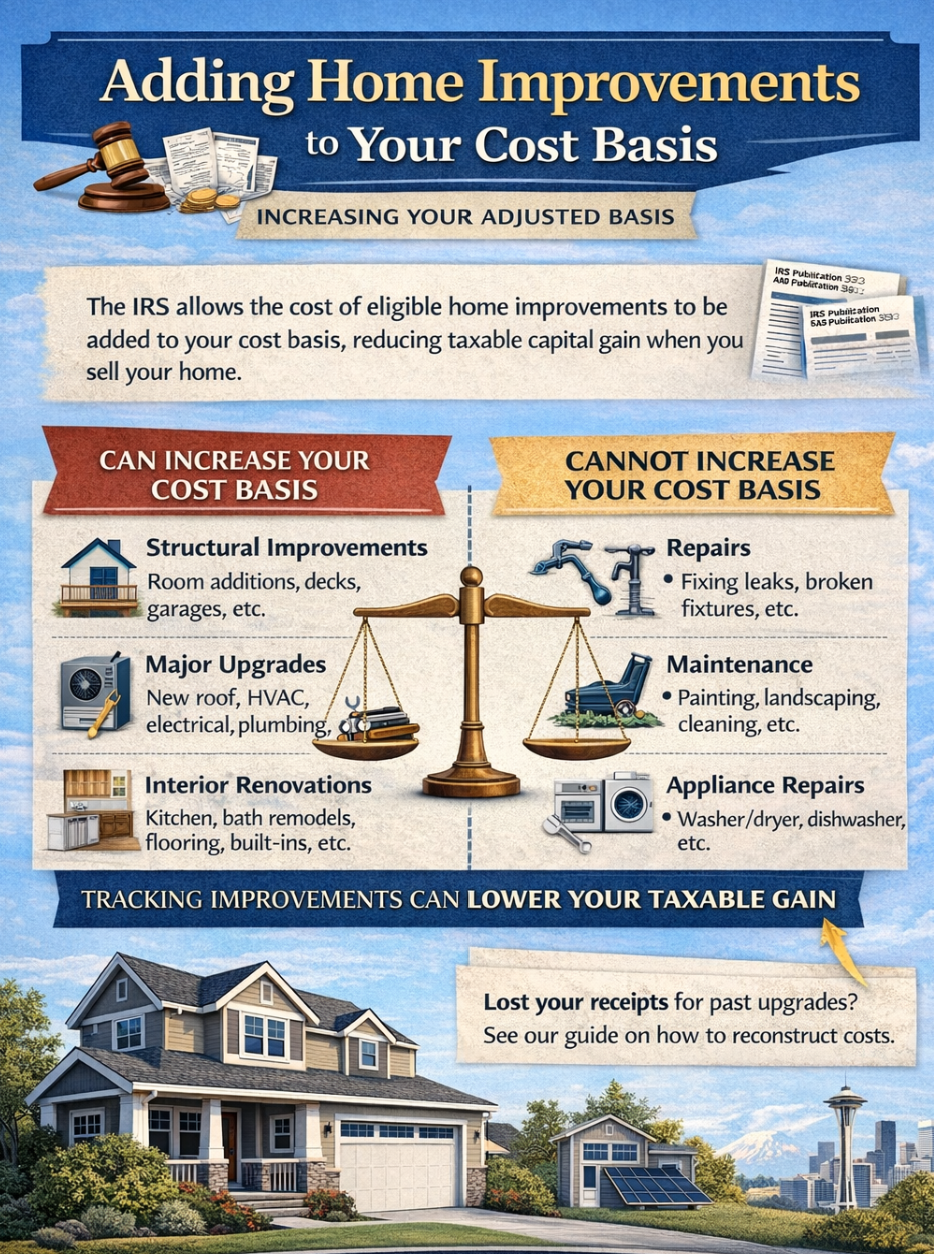
When you sell a home, your taxable gain is based on the difference between your sale price and your adjusted cost basis.
Many homeowners assume the basis is simply the price they originally paid for the property. In reality, the IRS allows you to increase your basis by the cost of many improvements made over time.
Understanding which costs count—and which do not—can significantly reduce the amount of gain subject to tax.
For homeowners who have owned a property for many years, these adjustments can be substantial.
Guidance on calculating basis adjustments can be found in
IRS Publication 523 and
IRS Publication 530.
What Is Adjusted Basis?
Your adjusted basis typically starts with:
- The purchase price of the home
- Certain closing costs paid when you purchased
Over time, the basis may be increased by capital improvements and decreased by certain deductions or credits.
When you sell, your taxable gain is calculated roughly as:
Sale price
– selling costs
– adjusted basis
= capital gain
Because improvements increase the adjusted basis, they reduce taxable gain.
Improvements That Can Increase Your Basis
The IRS generally allows improvements that add value, extend the life of the property, or adapt it to new uses.
These are often referred to as capital improvements.
Common examples include:
Structural Improvements
- Room additions
- Finishing a basement or attic
- Adding a garage
- Decks, patios, or porches
Major System Replacements
- Roof replacement
- New HVAC system
- Furnace or heat pump
- Plumbing or electrical upgrades
Interior Renovations
- Kitchen remodels
- Bathroom renovations
- Flooring replacement
- Built-in cabinetry
Exterior Improvements
- New siding
- Window replacement
- Driveways or walkways
- Retaining walls
Energy Efficiency Improvements
- Solar panel installations
- Insulation upgrades
- High-efficiency windows
- Electrical upgrades needed for heat pumps or EV charging
Even improvements made decades earlier can be included in the adjusted basis.
Costs That Are NOT Included in Basis
Not every home-related expense counts as an improvement.
The IRS does not allow routine maintenance or repair costs to be added to basis.
Examples include:
- Interior painting
- Minor plumbing repairs
- Fixing leaks
- Replacing broken fixtures
- Cleaning or routine landscaping
- Appliance repairs
- Pest control
These costs are considered maintenance, not capital improvements.
The key distinction is that maintenance keeps the property in normal working order, while improvements increase value or extend the life of the home.
Improvements vs Repairs: A Quick Example
Consider two different scenarios involving a roof:
Repairing a small roof leak
→ Maintenance (not added to basis)
Replacing the entire roof
→ Capital improvement (included in basis)
Don’t Forget Improvements Made Before Selling
If you make improvements shortly before selling your home, those costs may also increase basis.
Examples include:
- Installing a new roof before listing
- Remodeling a kitchen before sale
- Replacing outdated windows
However, routine staging, cleaning, or cosmetic touch-ups generally count as selling expenses rather than basis adjustments.
What If You Lost Your Improvement Records?
Many homeowners have owned their homes for decades and no longer have receipts for major improvements.
This is common with projects completed many years ago.
Fortunately, taxpayers may often reconstruct reasonable estimates of improvement costs using other forms of documentation.
This can include:
- Contractor records
- Permit records
- Insurance files
- Historical cost estimates
We discuss this in detail in a separate article explaining what to do if you’ve lost records of past improvements and how to reconstruct those costs for tax purposes.
Why This Matters for Long-Term Homeowners
Over decades of ownership, improvements can add up to hundreds of thousands of dollars.
Properly accounting for those improvements can significantly reduce taxable gain when selling.
Many homeowners still qualify for the $250,000 / $500,000 capital gains exclusion under
IRC Section 121.
But if the gain exceeds that exclusion, accurately calculating the adjusted basis becomes even more important.
Final Thoughts
Before selling your home, it can be helpful to:
- Review your purchase records
- Gather documentation for major improvements
- Talk with your tax professional about how those improvements affect your adjusted basis
Even improvements made many years ago can meaningfully reduce taxable gains.
And if you no longer have documentation, don’t panic—there are often ways to reconstruct those records. Our related article explains how homeowners can do exactly that.