Published February 26, 2026
Tax Free Money? The Power of Section 121 Capital Gains Exclusion

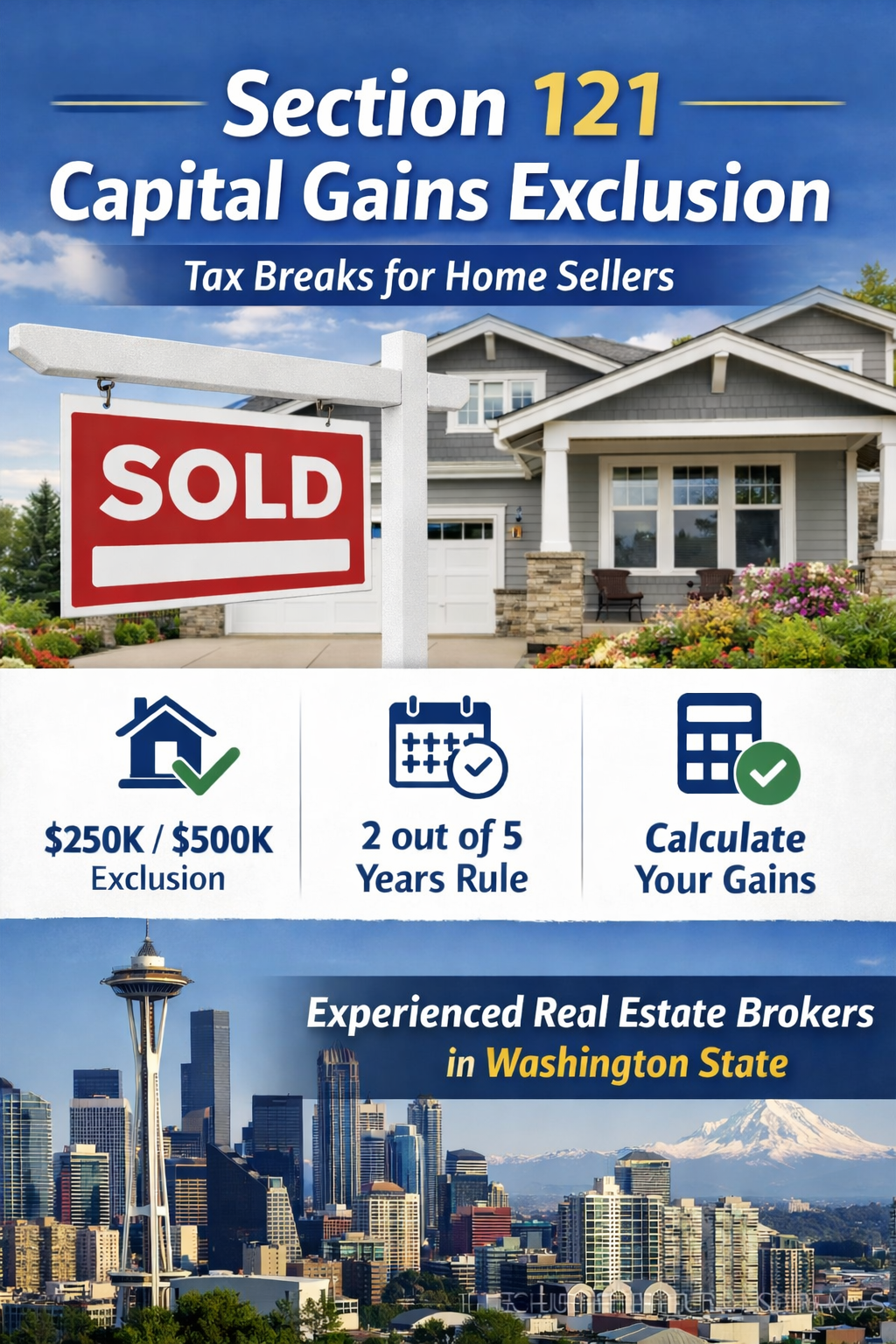
How Home Sellers Can Potentially Avoid Capital Gains Tax
If you’ve owned your home for more than a few years and are thinking about selling, you might be wondering:
Will I owe capital gains tax?
The good news: most homeowners qualify to exclude a large portion of their gain under Section 121 of the Internal Revenue Code.
Here’s what you need to know.
What Is the Section 121 Exclusion?
Section 121 allows homeowners to exclude:
- Up to $250,000 of capital gains (single filers)
- Up to $500,000 of capital gains (married filing jointly)
If your gain falls under those limits, you may owe zero federal capital gains tax on the sale. For many homeowners in Snohomish and King County, this covers the entire gain.
The Two Core Requirements
To qualify, you must meet the:
1. Ownership Test
You owned the home for at least 2 years during the 5-year period before the sale.
2. Use Test
You lived in the home as your primary residence for at least 2 years during that same 5-year window.
The two years:
- Do not have to be consecutive
- Do not have to be the most recent 2 years
- Can overlap
The 2-Out-of-5-Year Rule
Think of it this way:
If you sell in 2026, the IRS looks back to 2021–2026.
If you owned and lived in the home for at least 24 months in that window, you likely qualify.
This flexibility is powerful.
It allows:
- Job relocations
- Temporary rentals
- Strategic moves
Married Couples: How the $500,000 Works
To claim the full $500,000 exclusion:
- One spouse must meet the ownership test
- Both spouses must meet the use test
- Neither spouse used the exclusion in the past 2 years
If only one spouse qualifies, the exclusion may drop to $250,000.
What Counts as “Gain”?
Capital gain/loss is the profit or loss you incur when selling an asset and is roughly calculated in the following way:
- Sale Price
- Less "Adjusted Basis", which is the sum of:
- Purchase Price
- Purchase Closing Costs
- Costs of Sale (Closings Costs, Commissions, Taxes)
- Capital Improvements
- Plus Depreciation Recapture (if property was an investment)
- Capital Gain (Or Loss)
This is where documentation matters. If you added $150,000 in improvements during the ownership of the home, you can significantly reduce your taxable gain.
What About Rentals or Investment Use?
This is where it gets nuanced. If the property was:
- A rental before becoming your primary residence
- A primary residence converted to rental
- Mixed-use
You may still qualify for partial exclusion. However:
- Depreciation taken after May 6, 1997 must be recaptured
- “Non-qualified use” periods may reduce the exclusion
This is common in our market where homeowners convert properties to rentals before selling. Strategic timing can make a six-figure tax difference.
The Once-Every-Two-Years Rule
You can only claim the Section 121 exclusion once every two years.
Planning matters if you:
- Move frequently
- Own multiple properties
- Flip primary residences
Special Situations
You may qualify for a partial exclusion if you sell early due to:
- Job relocation
- Health reasons
- Unforeseen circumstances
The IRS allows prorated exclusions in these cases.
Real-World Example
Here's a how this works in the real world:
- Purchased a home in 2018 for $800,000 and invest $150,000 in updates, remodels & improvements during ownership.
- Sell in 2026 for $1,500,000 paying $50,000 in selling costs.
- Adjusted basis: $800,000 + $150,000 + $50,000 = $1,000,000
- Capital gain: $1,500,000 – $1,000,000 = $500,000
If married and qualifying under Section 121, you may owe no federal capital gains tax. If you are a single filer, then your taxable gain is reduced by $250,000 and the remaining gain may be taxable at long term rates.
Washington State Note
Washington has:
- No state income tax
- But does have a state capital gains tax on certain investment assets
Primary residences are generally excluded from Washington’s capital gains tax, but high-net-worth scenarios deserve review.
Why This Matters in Today’s Market
Many Western Washington homeowners have:
- Significant appreciation
- Low basis
- Large equity positions
Before you list your home, ask:
- Do I qualify?
- Should I wait to meet the 2-year rule?
- Should I convert a rental back to primary residence first?
- How does depreciation impact me?
Timing your sale properly can change your after-tax proceeds dramatically.
Smart Sellers Plan Before They List
The biggest mistake I see?
Sellers asking tax questions after they’re already under contract.
By then, flexibility is limited.
If you're considering selling in the next 6–24 months, now is the time to model:
- Estimated net proceeds
- Capital gains exposure
- Optimal sale timing
- Improvement documentation strategy
Want a Personalized Net Proceeds + Tax Exposure Estimate?
I help homeowners evaluate:
- Current market value
- Likely sale price range
- Selling costs
- Potential capital gains exposure
If you'd like a confidential review of your scenario, reach out. A 20-minute conversation today can protect hundreds of thousands in equity tomorrow.
Disclaimer: This article is for educational purposes only and is not tax or legal advice. Always consult a qualified CPA or tax attorney regarding your specific situation.