Published January 6, 2026
Puget Sound Housing Market Look Ahead: 2026 (Seattle + the North Sound)


You’re heading into a market that feels very different than 2020–2022.
Not because demand disappears.
Because rates, inventory, and buyer psychology are resetting the rules.
Here’s what the best national and local forecasters are signaling for 2026—and how to turn it into an advantage.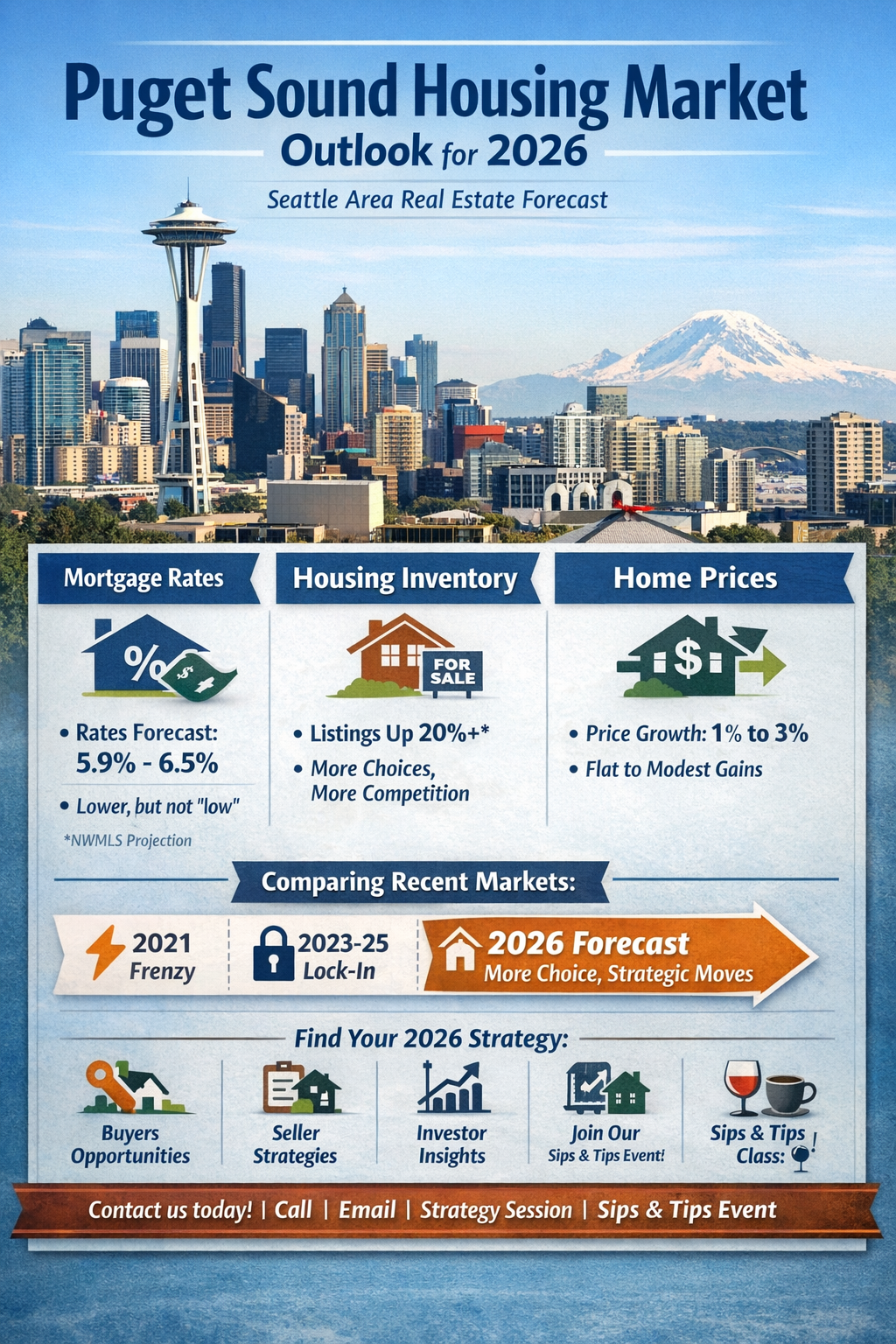
The 3 forces that will shape 2026 in our area
1) Mortgage rates: “Lower… but not low”
Most major forecasts cluster in the low-6% range for 2026.
Some are more optimistic by late year.
- MBA: rates stay stubborn, around the mid-6% range (many summaries cite ~6.4% average). Scotsman Guide+1
- Realtor.com: forecasts mortgage rates averaging ~6.3% in 2026. Realtor
- Fannie Mae: projects rates ending 2026 around 5.9%. Fannie Mae
- S&P Global Ratings: forecast has 30-year fixed dropping to about 5.55% in Q4 2026. S&P Global
Reality check for your planning:
- Plan purchases at 6.5%.
- Treat anything with a closer to 6.0% or less as an opportunity window.
Rates ended 2025 around the low-6% range nationally, which matters because 2026 momentum often starts with what buyers feel in January. AP News
2) Inventory: improving, but still not “normal”
This is the quiet story that creates real leverage.
Locally, we already saw a meaningful shift in late 2025:
- NWMLS reported active listings up nearly 24% year-over-year (Nov 2025). Northwest Multiple Listing Service
More selection changes everything:
- Fewer panic offers
- More inspection leverage
- More price discovery (especially on homes that miss the mark)
But don’t expect a flood.
The “rate lock” effect is still real. Owners with 3–4% mortgages may not list unless life forces the move.
3) Prices: flatter, more neighborhood-driven
National forecasters are calling for modest growth, not a crash.
- NAR / Lawrence Yun: home price growth likely ~2% to 3% in 2026. National Association of REALTORS®
- Zillow: national home values up ~1.2% in 2026 (forecast). investors.zillowgroup.com+1
Local expectations:
- Matthew Gardner's 2026 view: expects prices roughly flat, citing higher inventory putting pressure on values. Matthew Gardner via Facebook
That’s not “prices collapsing.” That’s a market repricing toward long term realism.
How 2026 compares to recent years
2020–2021: Speed market
- Low rates
- Tiny inventory
- Winning meant removing protections
2022: Rate-shock market
- Payment jump
- Demand stalled
- Sellers took time to adjust expectations
2023–2025: Lock-in market
- Owners stayed put
- Buyers became selective
- Pricing became hyper-local
2026: The “selection + strategy” market
- More listings than the last couple years (not 2018 levels, but better) Northwest Multiple Listing Service
- Rates likely drift lower, not collapse Realtor+2Fannie Mae+2
- Prices likely move modestly overall, while neighborhoods diverge National Association of REALTORS®+2Windermere Real Estate+2
If you’re waiting for one clean signal—“rates are back” or “prices are down big”—you may miss the best windows.
Where the 2026 opportunities will be
If you’re a buyer
Your edge is choice.
And choice creates leverage.
Look for:
- Homes sitting longer because they were priced like 2022
- Cosmetic fixers with strong bones
- New construction or spec homes with incentives (rate buydowns, closing costs)
Your best move:
- Get fully underwritten early.
- Be ready to strike when rates dip.
- Write offers that protect you, but still feel clean to a seller.
Ask yourself:
- Are you shopping payment-first, or price-first?
- If rates hit 5.9% late-year, will you be ready—or scrambling? Fannie Mae
If you’re a seller
Your edge is preparation + precision.
The days of “list it and see” are fading.
You win by:
- Pricing to today’s data, not last spring
- Fixing condition issues buyers now notice
- Creating a launch plan that makes your first 7 days count
Because buyers now have options.
And options make them picky.
What to watch:
- If inventory keeps improving, “pretty good” homes get punished.
- “Turnkey + well-positioned” still sells fast.
If you’re an investor
Your edge is math + patience.
2026 looks like a year where:
- Appreciation is likely modest National Association of REALTORS®+1
- Financing matters more than ever Realtor+1
- Value-add strategy beats speculation
Where investors can win:
- Small cosmetic rehabs with realistic ARVs
- Properties that support multigenerational living (demand trend is growing nationally) Axios
- ADU potential in the right jurisdictions (especially when rents support the build cost)
Key investor question:
- If appreciation is 1–3%, can the deal stand on cash flow and forced value? National Association of REALTORS®+1
What we’ll be watching month-by-month in 2026
You don’t need 20 metrics.
You need the few that change leverage fast:
- Mortgage rate trend (weekly) AP News
- Active listings vs. last year (NWMLS) Northwest Multiple Listing Service
- Months of supply (who has leverage)
- Price reductions (seller motivation signal)
- Pending sales (demand before closings show up)
Your next step (pick one)
If you want a clear plan for 2026—based on your timeline and your neighborhood—let’s talk.
- Call us
- Email us
- Schedule a strategy meeting
- Or come to our next Sips & Tips class: https://www.connectingyouhome.com/sipsandtips
Bring your questions.
Especially the ones you’re not sure are “smart” to ask.
Those are usually the ones that save you the most money.