Published June 20, 2022
Passive Vs. Active Investment Management: The Buffett Bet

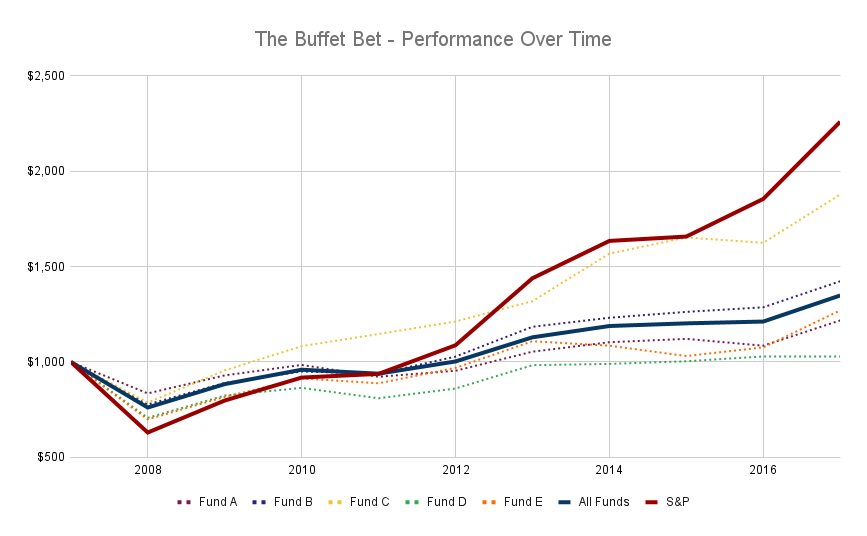
While Warren Buffett is arguably the most successful active investor in history, he strongly believes his performance is unusual, and in the vast majority of cases, the market itself outperforms high turnover, high cost active investors such as hedge funds. In 2007, he put money behind his beliefs with a $1,000,000 charitable bet open to any fund manager seeking to prove the superiority of their results. Somewhat surprisingly, it took many months for a hedge fund manager to take the bet, though finally Ted Seides of Protege Partners bet his ‘Fund of Funds’ representing the combined performance of more than 100 individual hedge funds would outperform the S&P 500 over the next 10 years.

The bet started on January 1, 2008, which was quite unfortunate timing for Buffett, as the S&P index fund lost more than 37% of its value during the start of the great recession. Meanwhile, the hedge funds were able to limit losses to just 23.9% in this first very tough year. However, for the next 9 years Buffett's passive fund outperformed the hedge funds, recovering all lost ground by 2012 and never looking back. In fact, 9 of the 10 years the passive fund outperformed the hedge funds, and by the end of the bet in 2017, the passive approach had gained 125.8% compared to 36.3% for the hedge fund.

Of course, this is one data point in a large field of data contrasting active versus passive investing, and there are certainly cases where active investing either through skill, timing or simple luck will outperform passive investment. That said, in the big picture even when accounting for highly skilled professionals active in their field, the market itself most often provides better results due to much lower management costs and mitigation of risks through greater diversification.
Applicability To Real Estate Investment
The same basic principles apply to real estate. Buying smart and holding for long periods of time is the low cost, low risk and most often higher return approach to building wealth. While there is money to be made in short term flipping & development, this comes with much higher transactional, development and management costs as well as greater exposure to short term market fluctuations and adjustments... all of which raise the potential risk profile of this form of investing. For most looking to build long term wealth without specialized skills & experiences, industry connections or vast amounts of time, long term passive real estate investment such as home ownership, as well as rental and vacation property ownership are the best path to wealth building with a low risk profile.