Published March 5, 2026
Mortgage Interest and Mortgage Insurance Deductions for Homeowners (2025 Guide)

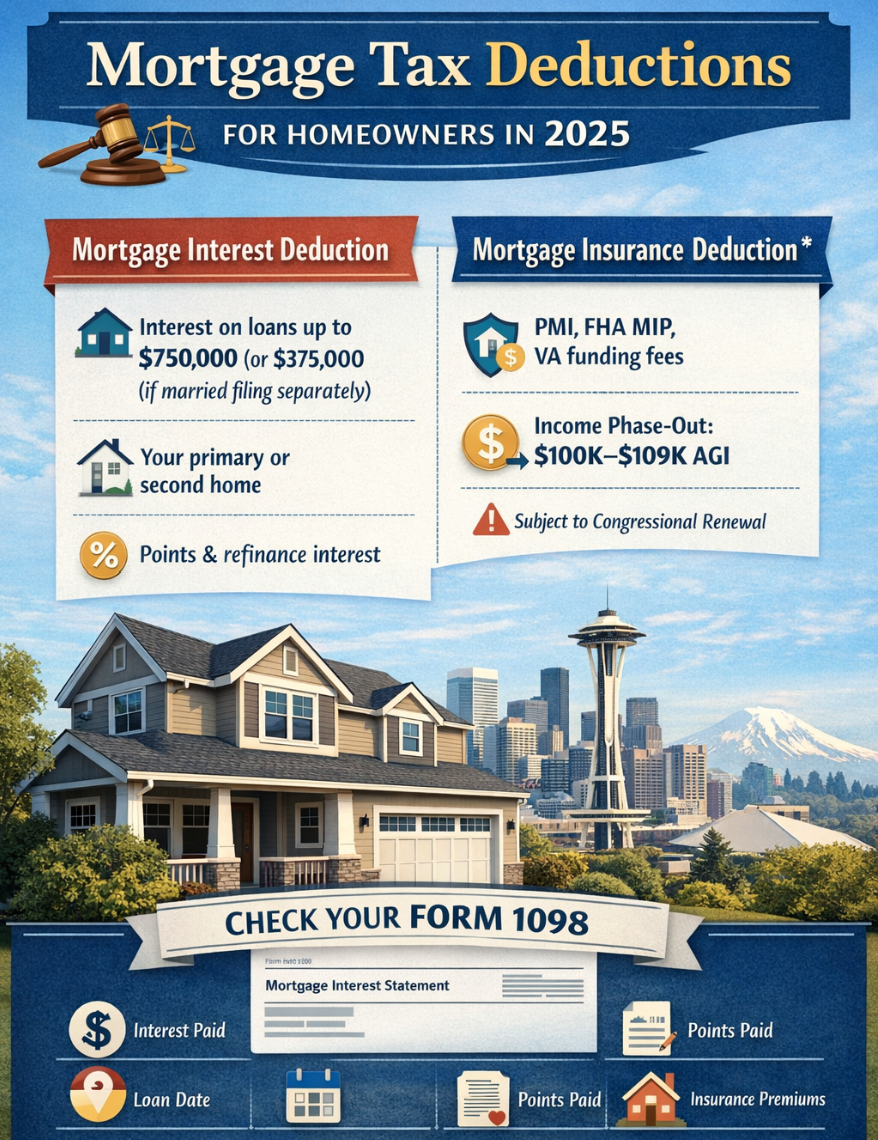
Owning a home comes with meaningful tax benefits. Two of the most common are the mortgage interest deduction and the mortgage insurance premium deduction.
Both can reduce your taxable income if you itemize deductions.
Here’s how the rules apply for the 2025 tax year.
Mortgage Interest Deduction
Form 1098
Most homeowners receive Form 1098 from their lender each January.
This form reports the total mortgage interest you paid during the previous year.
If you itemize deductions on your tax return, that interest may be deductible.
Key rules for 2025
The deduction generally applies if:
- The loan is secured by your primary residence or a second home
- The loan was used to buy, build, or substantially improve the property
- You itemize deductions instead of taking the standard deduction
Mortgage debt limits
For mortgages originating after December 15, 2017:
- Interest is deductible on up to $750,000 of mortgage debt
- Married filing separately: $375,000
Older mortgages may still qualify for the previous $1 million limit.
What counts as deductible interest
Common examples include:
- Regular mortgage interest payments
- Interest on refinanced loans (within limits)
- Points paid when purchasing a home
- Prepaid interest shown on closing statements
Interest on home equity loans or HELOCs is only deductible if the funds were used to improve the home securing the loan.
Using home equity for other purposes—such as paying off credit cards or buying a car—does not qualify.
Mortgage Insurance Premium Deduction
Some buyers put down less than 20% when purchasing a home.
Lenders often require mortgage insurance in those cases.
Common forms include:
- PMI (Private Mortgage Insurance) on conventional loans
- MIP on FHA loans
- Funding fees on certain VA or USDA loans
Mortgage insurance premiums have historically been deductible as an itemized deduction.
However, the availability of this deduction has changed frequently due to congressional extensions.
Status for 2025
As of now:
- The deduction has not been permanently extended beyond prior temporary authorizations
- Congress has periodically renewed it retroactively
Because of this uncertainty, homeowners should verify the rule when preparing their 2025 tax return in early 2026.
Income phase-outs (when the deduction is allowed)
When the deduction is in effect, it typically phases out as income increases:
- Begins phasing out at $100,000 AGI
- Fully phased out at $109,000 AGI
- Married filing separately: phase-out begins at $50,000
Standard Deduction vs Itemizing
These deductions only help if you itemize.
For many households, the standard deduction is large enough that itemizing does not produce additional savings.
For reference, recent standard deductions have been roughly:
- Married filing jointly: around $29,000+
- Single filers: around $14,000+
Homeowners often itemize if they have:
- Significant mortgage interest
- Property taxes (subject to SALT limits)
- Charitable donations
- Medical deductions
Records Homeowners Should Keep
Maintaining good records makes tax preparation much easier.
Important documents include:
- Your Form 1098 from the lender
- Your closing statement when you purchased or refinanced
- Records of points paid
- Statements showing mortgage insurance premiums
These documents help ensure you receive the deductions you qualify for.
Final Thoughts
Mortgage-related tax deductions can provide meaningful savings for homeowners who itemize.
For 2025:
- Mortgage interest remains one of the most reliable homeowner deductions.
- Mortgage insurance deductions may depend on whether Congress extends the provision again.
If you own a home or are considering buying one, understanding these rules can help you plan ahead and avoid surprises at tax time.
IRS Resources
For homeowners who want to explore the tax rules in more detail, the IRS provides the following official guidance:
- Form 1098
Reports mortgage interest your lender received during the year.
https://www.irs.gov/forms-pubs/about-form-1098 - Schedule A (Form 1040)
Used to claim mortgage interest, property taxes, and other itemized deductions.
https://www.irs.gov/forms-pubs/about-schedule-a-form-1040 - IRS Publication 936
The primary IRS guide explaining which mortgage interest qualifies and the loan limits.
https://www.irs.gov/publications/p936 - IRS Publication 530
Broader overview of tax rules affecting homeowners, including mortgage interest, property taxes, and basis adjustments.
https://www.irs.gov/publications/p530 - IRS Publication 17
General IRS guide that summarizes major deductions and tax rules for individuals.
https://www.irs.gov/publications/p17
“Tax rules can change frequently, so homeowners should consult the IRS publications below or speak with a qualified tax professional for advice specific to their situation.”