Published September 3, 2026
Why NWMLS Built First Look — And What It's Replacing

Starting tomorrow, September 4, Northwest Multiple Listing Service is rolling out a new listing status called First Look. It's the biggest change to how homes move onto the market in this region in years, and if you've heard us mention it already, it's because we think every seller in King and Snohomish counties should understand where it came from before they decide whether to use it.
First Look didn't appear out of nowhere. It's NWMLS's answer to a problem that's been building in real estate for a few years now — one that a new Washington State law just made impossible to ignore.
The Problem: Phased, Private Marketing
Over the past several years, a handful of large national brokerages — most visibly Compass — built marketing programs that move a listing through stages before it ever reaches the open market. A typical version works like this: a home is first shared only within the listing brokerage's own network of agents and buyers ("private exclusive"), then opened a little wider to a limited group, and only later — sometimes weeks later, sometimes not at all — published to the full Multiple Listing Service and broadly syndicated to public sites like Zillow and Redfin.
For the brokerage running that program, the appeal is obvious. For the seller, the trade-offs are less obvious and, in our view, worth spelling out plainly:
A narrower buyer pool. The entire value of a competitive listing launch comes from concentrated attention — the largest possible number of ready buyers discovering a home at the same moment, under real time pressure to act. A private or limited-network listing doesn't get that. It reaches only the buyers already inside one brokerage's ecosystem, while buyers working with every other firm — likely the majority of buyers in any given market — may never see it until it reaches the open market, if it ever does.
A built-in conflict of interest. Here's the part that draws the sharpest criticism. When a listing brokerage keeps a home inside its own private network for the early, most price-sensitive stage of marketing, that same brokerage's buyer-side agents get first crack at it — before any other firm's buyers even know it exists. That structure gives the brokerage a real incentive to find the buyer in-house rather than to maximize the number of buyers competing for the home, because representing both the seller and the buyer means collecting both sides of the commission. That's not a hypothetical: it's the specific dynamic that industry critics, regulators, and eventually Washington State lawmakers pointed to as the core problem with phased marketing. A seller's agent is supposed to be working to get the seller the best possible outcome through maximum competition — not managing a private pipeline that happens to be more profitable for their own firm.
Neither of these problems is unique to any one company, and there was a real answer some sellers were given for why a private or phased launch might make sense — privacy, testing a price, keeping a home "off the radar" while it's prepared for sale. But the trade-off was rarely made explicit: a smaller buyer pool at exactly the moment competition matters most, in exchange for a marketing approach that also happened to benefit the brokerage's own bottom line.
Washington's Response: RCW 18.86.130
The Washington State Legislature addressed this directly. RCW 18.86.130, part of Senate Bill 6091 and effective June 11, 2026, prohibits a real estate broker from marketing a residential listing to a limited or exclusive group of buyers or brokers unless it is simultaneously marketed to the general public and to all other brokers. The law carves out one narrow exception — genuine health or safety concerns for the seller or occupant — and nothing else. In plain terms: if you're going to market a home for sale in Washington, you have to actually market it, to everyone, at the same time. Quietly keeping it in-house first is no longer an option absent a real safety reason.
That law didn't leave phased marketing models with much room to operate in this state. It also created a practical gap: what about sellers who have a genuine reason to want a short runway — a home that isn't staged yet, photography that isn't finished, repairs still underway — before their listing is ready for the spotlight of a full public launch?
NWMLS's Answer: First Look
That's the gap First Look is built to fill. Rather than letting brokerages solve that problem with a private, in-house workaround, NWMLS created a status that gives every seller — regardless of which brokerage they use — the same structured option: a listing period of up to 21 days that is visible to all 30,000+ NWMLS member brokers from day one (never private, never a "pocket listing"), during which the seller decides, independently, whether to allow showings and whether to display the listing broadly on public sites like Zillow and Redfin.
NWMLS has described First Look as resolving pending litigation with Compass while "reaffirming its commitment to an open and comprehensive marketplace." Read alongside RCW 18.86.130, the intent is clear: give sellers real prep-time flexibility, without recreating the closed, brokerage-controlled marketing pipeline the new law was written to close off. Every First Look listing is broker-visible immediately, and — for the overwhelming majority of sellers — the law itself effectively requires public marketing too, since opting out of public display without a genuine health or safety reason is a legally exposed choice, not a routine preference.
This Didn't Happen Through the Normal Process
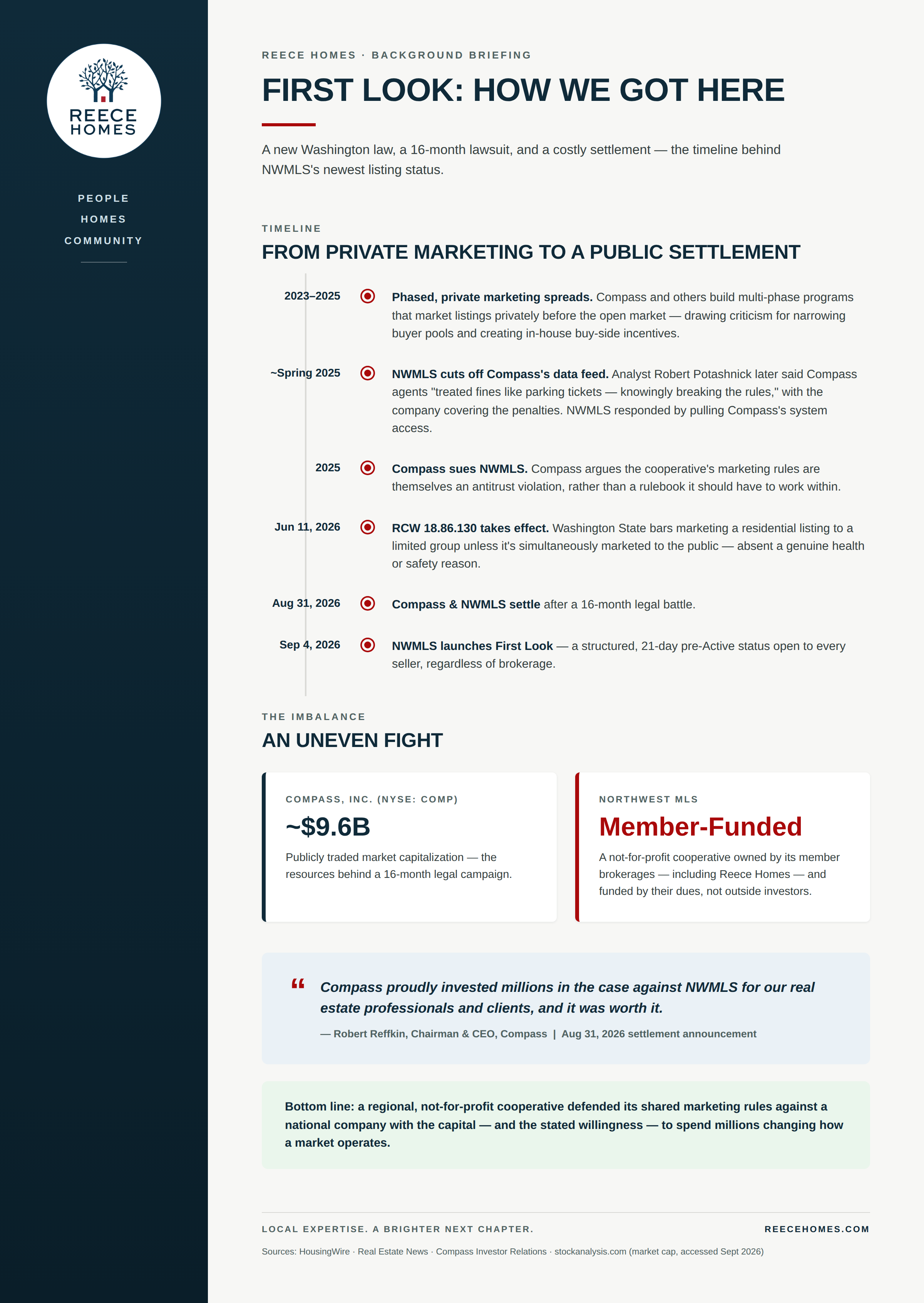
It's worth understanding how NWMLS actually arrived at First Look, because it wasn't through the cooperative's ordinary rulemaking process. According to Robert Potashnick, founder of the Real Estate Intelligence Agency, Compass agents in this market didn't wait for NWMLS's rules to change before deviating from them — Potashnick told HousingWire that "Compass treated fines like parking tickets — knowingly breaking the rules," and that Compass reportedly told its own agents not to worry about the resulting penalties because the company would simply pay them.[^1] NWMLS eventually responded by cutting off Compass's access to its data feed. Compass sued shortly after, arguing that the cooperative's rules were themselves an illegal restraint of trade rather than a shared rulebook a competitor should have to work within like everyone else.
Sixteen months of litigation later, the two sides settled on August 31, 2026.[^2] Compass didn't shy away from what the fight cost to get there. Chairman and CEO Robert Reffkin said of the settlement: "Compass proudly invested millions in the case against NWMLS for our real estate professionals and clients, and it was worth it."[^3]
That's worth sitting with for a moment. NWMLS is a member-owned, not-for-profit cooperative — it isn't backed by outside investors, it runs on the dues and fees of the same local brokerages it serves, including ours. Compass is a publicly traded company with a market capitalization of roughly $9.6 billion.[^4] "Millions" in legal fees is real money for a member-funded nonprofit defending its rulebook; for a company Compass's size, it's a cost of doing business, and one it says outright it was glad to pay to get the marketing rules it wanted. Whatever anyone thinks of the merits of Clear Cooperation-style rules, that's a meaningfully uneven fight — a regional, not-for-profit cooperative defending shared rules for its member brokerages against a national company with the capital and the stated willingness to spend it to change how a market operates.
Where This Leaves Sellers
First Look launches tomorrow, and we'll be watching closely how it actually performs in practice — how the major real estate platforms display it, and how buyers and their agents respond to a status this new. We'll have more on that soon, along with our specific recommendation for sellers bringing a home to market in the weeks ahead. For now, the important thing to understand is what problem this status is solving, and why: not a new marketing gimmick, but a direct, structural response to a private-marketing model that was working better for some brokerages than it was for the sellers they represented.
[^1]: Real estate industry reacts to Compass-NWMLS lawsuit, HousingWire. [^2]: Compass, NWMLS settle 16-month legal battle, Real Estate News, August 31, 2026. [^3]: Compass-NWMLS Settlement Gives Washington State Homeowners Phased Marketing Choices for the First Time Ever, Compass Investor Relations, August 31, 2026. [^4]: Compass (COMP) Market Cap & Net Worth, stockanalysis.com, accessed September 2026 (~$9.6B).